
'These people were your darlings, they were being dined and wined in the White House and now you say go to hell Pakistanis'

It is important the SCO focus strongly on economic development and regional integration that leads to greater benefits for the least developed regions of member-countries, writes Sana Hashmi.

'Chinese dominance reduces India's influence in South and Southeast Asia and erodes its status globally.' 'For a country striving to create a multipolar Asia, it would be a serious setback,' says Brigadier S K Chatterji (retd).

'Whatever the two countries are doing these days, on the diplomatic front and on their borders, that hostility is not sustainable.' 'Today's world doesn't approve it.'

India on Tuesday supported Afghanistan's reconciliation process with the Taliban, but warned that it must not undermine the legitimacy of the Afghan government and should be within the internationally accepted "red lines".

India must also not rule out dialogue with Pakistan. However, talks with Pakistan must be structured, and further progress must be based on visible results.

Prime Minister Narendra Modi on Wednesday held bilateral talks with all Heads of Government and State attending the 18th SAARC Summit in Kathmandu with Pakistan Prime Minister Nawaz Sharif the only conspicuous exemption.
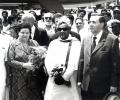
'I was present at a meeting where he decided to permit the IAF to strike at Pakistan positions in Kargil, with the caveat that they should not cross the LoC.' 'Confident that the Indian Army would succeed, Mr Vajpayee was positioning himself to tell the world after the Kargil conflict was won that India did not violate the 'sanctity' of the LoC,' recalls Ambassador G Parthasarathy, who served as India's envoy in Islamabad in that eventful year, 1999.

Terrorism and Afghanistan were the focus points of Prime Minister Narendra Modi's talks with Uzbek President Islam Karimov on his first visit to Central Asia.

Seeking to strengthen Indo-UK economic ties, Prime Minister Narendra Modi on Thursday arrived in Britain on his first visit to the country during which he will have a hectic schedule that will start with talks with his British counterpart David Cameron.

An MoU on sharing hydrological information of the Brahmaputra River by China to India and another pact on amendment of the protocol on phytosanitary requirements for exporting rice from India to China to include non-Basmati rice were signed after the Modi-Xi talks in the eastern Chinese port city.

The ecosystems of India and China today jostle against one another across Asia and much of the world.

India and the United Kingdom on Thursday announced deals worth 9 billion Pound (Rs 90,550 crore) as they signed a civilian nuclear pact and decided to collaborate in the field of defence and cyber security besides launching a railway rupee bond in London.

Setting aside the recent tumult in relations caused by the Khobragade episode, US Deputy Secretary of State Heather Higginbottom attended the first major event India's new Ambassador Dr S Jaishankar hosted in Washington. Rediff.com's Aziz Haniffa reports from the Republic Day celebration in the US capital.

Prime Minister Narendra Modi had gone to China with a bagful of initiatives, but not all seems to have been fulfilled given China's reluctance to go the whole hog with him
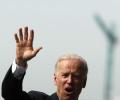
United States Vice President Joe Biden on Monday left for a rare vice presidential trip to India for the first leg of his visit to the Asia-Pacific region.

'We will have to wait till the snows melt in June/July 2016 before we can get a clearer idea of whether Pakistan intends to get serious about ending support for cross-border terrorism,' says G Parthasarathy, India's former high commissioner to Pakistan.

This is the time when the US would need the conceptual strategic thinking of a Henry Kissinger, able to ally diplomatic skills with a well-conceived worldview of what the emergence of a new balance of forces will mean for a US whose ability to shape global events has definitely declined but still exists, says Claude Smadja.

The United States is looking forward to a "very substantive and consequential" visit by Prime Minister Narendra Modi to Washington later next month and is working on a "pretty ambitious roadmap" for his bilateral meeting with President Barack Obama, a top American official said.

'The past year has yielded extraordinary results in the strategic, commercial, and people-to-people components of the India-United States partnership, US Ambassador to India Richard Rahul Verma tells Aziz Haniffa/Rediff.com in an exclusive interview.

Being a pragmatist Modi is not likely to give preference to China over Japan. Both security and economic aspects are likely to shape Modi's decision in terms of engaging the two biggest economies of Asia, says Sana Hashmi.

Official talks were held between Modi and Seikh Tamim for multi-sectoral partnership and strengthening of Indo-Qatar ties following which the agreements and Memorandums of Understanding were signed on the second day of the Prime Minister's visit.
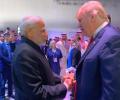
'India will come increasingly in the US crosshairs if it insists on maintaining its strategic autonomy, warns Ambassador M K Bhadrakumar.

Moving ahead with their new mantra -- Chalein Saath Saath: Forward Together We Go -- Prime Minister Narendra Modi and United States President Barack Obama on Tuesday vowed to deepen cooperation in every sector for the benefit of global stability and people's livelihoods over the next ten years.

'If India does venture across the LoC, it will evoke a strong response.'

'That the two sides allowed such a situation to arise exposed the level of inaction and inefficiency in China-India border management.' 'The Modi-Xi meeting in Xiamen initiated a process to to avert such contingencies in the future.'

As India strives to make its Act East Policy a comprehensive politico-diplomatic and economic success, Brunei gains more salience, says Dr Rahul Mishra.

'It is a tense border and there are numerous elements that keep these tensions alive.' 'India is willing to militarily respond if provoked.'

With Donald Trump the appeal has to be to his business instincts in which his personal interests seem to play a significant role, says former foreign secretary Kanwal Sibal.

Given our troubled relationship with Pakistan, we need to keep our security apparatus in a state of alert with state-of-the-art equipment. All bilateral issues with Pakistan -- political, military, economic -- will simply have to go on the back-burner till Pakistan decides it wants to live as a good neighbour, says Vikram Sood.

Prime Minister Narendra Modi enjoys a close relationship with Shinzo Abe. For Abe, "a strong India is in the best interest of Japan, and a strong Japan is in the best interest of India."

'Difficult issues should not be brushed under the carpet, but should be raised upfront, particularly by India. While engagement and dialogue are always welcome and desirable, there should be some tangible results. Mere signing of agreements, MoUs, joint declarations are not enough.'

Indian-Americans can make a "significant difference" in helping first ever woman United States presidential candidate Hillary Clinton break the ultimate glass ceiling.

'This is the first time the US has formally recognised the threat India faces from terrorist organisations based in Pakistan.'

Pak seeks US help to ease tensions with India.

'India does not wish to remain silent in improving its strategic space so that its leverage to counter China's expansionist designs is maintained, besides enabling it to play a responsible role from a position of strength for peace and stability in Asia,' points out Dr Rajaram Panda.

"This will be the first dinner for a foreign dignitary at the White House under this administration. So, we think that's very significant," a senior administration official told reporters at the White House on the eve of Modi's arrival.

These ambitious projects are littered with every possible acronyms and include proposed road links, air connectivity plans, electricity grids and special economic zones on coasts, says Subhomoy Bhattacharjee.
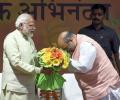
The Bharatiya Janata Party's landslide victory in state polls has "implications" for the Sino-India ties as it could further embolden Prime Minister Narendra Modi's "hard-line attitude" and pose difficulties for "compromises" in rows with countries like China, official Chinese media commented on Thursday.

'With the recent challenging of the notion of the Indian Ocean Region being India's strategic backyard, China is gradually upping the ante in the maritime realm around India.'
 © 2026 Rediff.com - Advertise with us - Disclaimer - Privacy Policy - Sitemap - Feedback - About us - Terms of use - Grievances